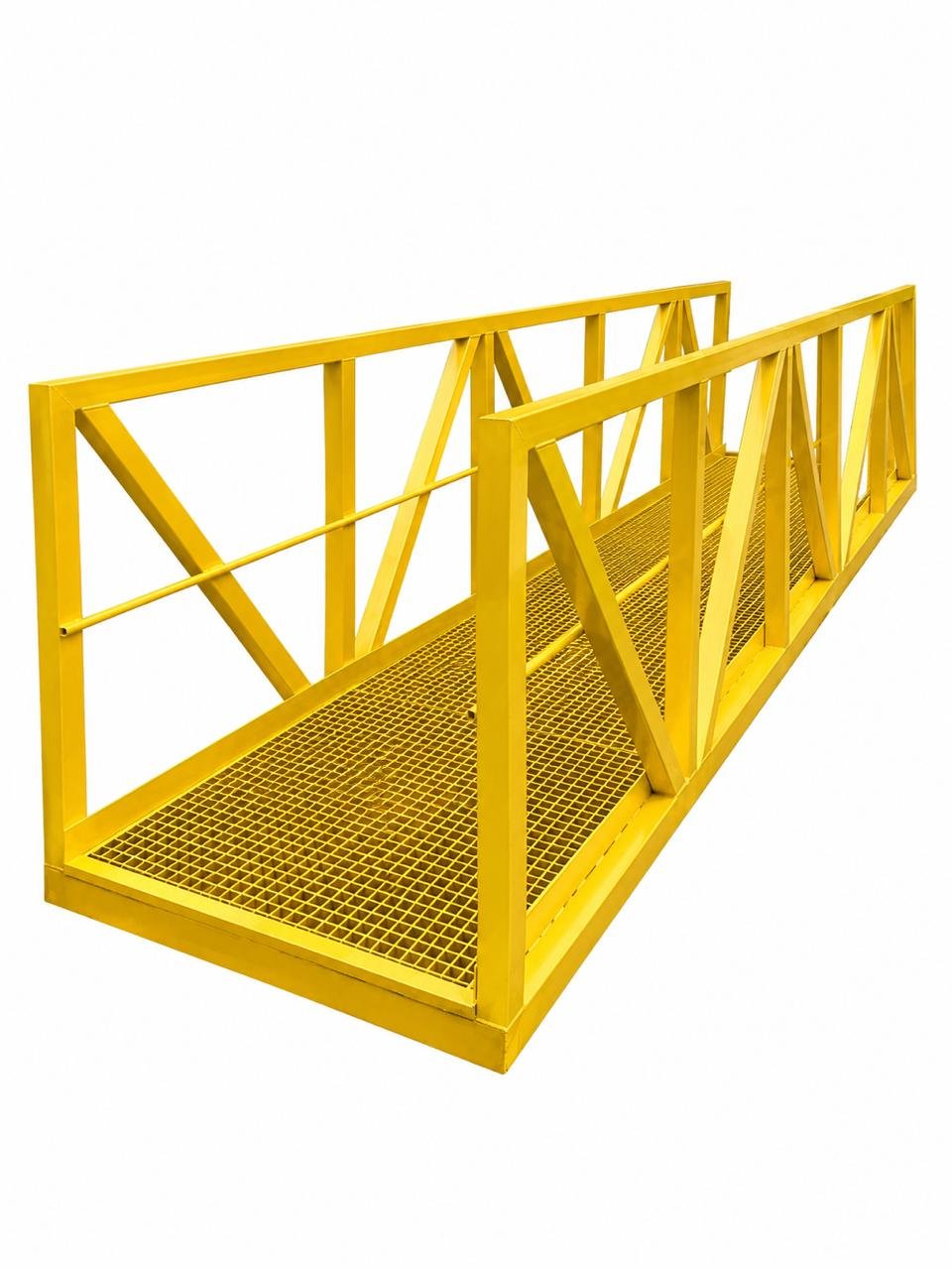
Offshore Gangway Manufacturer in Saudi Arabia (Steel & Aluminum)
Getting personnel and equipment safely between a vessel and a fixed platform, jetty, or another vessel is one of the more hazardous routine tasks offshore — deck levels rarely line up, and the vessel is constantly moving with the swell. A rigid, fixed walkway can’t cope with that motion, which is why an Offshore Gangway uses a hinged or roller-end connection that flexes with the vessel while keeping personnel on a secure, railed crossing.
Century Experts fabricates Offshore Gangways in both steel, for maximum load capacity in heavy-use environments, and aluminum, where lower weight makes manual deployment easier and reduces demand on deck crane capacity. Both versions are welded by qualified personnel under approved procedures, with full-length handrails, a non-slip walking surface, and either a fixed pivot or roller-end fitting selected based on how much relative vessel movement the connection needs to absorb.
We manufacture both standard and custom-built Offshore Gangways in various lengths, widths, and end-fitting configurations to match your vessel or platform’s specific access gap. Engineering calculations, proof load testing, and third-party certification can be provided upon request.
We proudly supply Offshore Gangways throughout Riyadh, Jeddah, Dammam, Jubail, Al Khobar, Yanbu, Ras Tanura, NEOM, and other regions of Saudi Arabia.
Applications
Our Offshore Gangways are suitable for:
- Vessel-to-Platform Personnel Access
- Jetty and Berth Crew Transfer
- Offshore Wind Turbine Access
- Ship-to-Ship Transfer Operations
- FPSO and Floating Facility Access
- Port and Terminal Crew Walkways
- Maintenance Access to Fixed Offshore Platforms
- Dive Support Vessel Access
- Offshore Construction and Hook-Up Projects
- Emergency Evacuation Routes
- Drilling Rig Crew Transfer
- General Marine Personnel Access Requirements
Features
- Available in steel or aluminum construction
- Roller-end or pivot-end fitting to absorb vessel movement
- Full-length handrails on both sides
- Non-slip walkway surface
- Anti-corrosion coating or natural aluminum corrosion resistance
- Engineered end brackets for vessel and platform connection
- Intermediate support legs for longer spans
- Smooth weld finish
- Custom lengths and widths to match access gap
- Identification plate with rated capacity and serial number
- Suitable for offshore, coastal, and marine environments
Why Choose Century Experts
- Custom-designed fabrication solutions
- Experienced engineering and fabrication team
- High-quality workmanship
- Qualified welding procedures
- Engineering calculations available
- Proof load testing available
- Third-party inspection support
- Fast manufacturing and delivery
- Complete documentation package
- Supply across all regions of Saudi Arabia
Standards & Compliance
Our Offshore Gangways are designed and manufactured in accordance with applicable project requirements and internationally recognized standards, including:
- EN ISO 14122 – Permanent Means of Access to Machinery
- DNV Offshore Access Standards (where applicable)
- Third-party inspection requirements (upon client request)
- Client specifications and project requirements
Compliance is subject to the approved design, client specifications, applicable project requirements, and relevant regulatory standards.
Frequently Asked Questions (FAQ)
1. What is an Offshore Gangway?
An Offshore Gangway is a walkway structure fitted with a flexible end connection, used to provide safe personnel access between a vessel and a fixed platform, jetty, or another vessel, designed to accommodate the relative motion between the two connection points.
2. Which is better for our operation — steel or aluminum?
Steel handles higher loads and heavier foot traffic at a lower cost, while aluminum is significantly lighter, which matters if the gangway needs to be manually repositioned or if deck crane capacity is limited. The right choice depends on your typical load, deployment method, and crane availability.
3. How much vessel movement can the gangway absorb?
This depends on the end-fitting type. A roller end allows the gangway to slide along the receiving deck as the vessel rises and falls with the swell, while a pivot end allows angular movement at a fixed point, sized based on the expected tidal range and sea state at the location.
4. Do you supply the mounting hardware for both ends?
Yes. We can supply matching end brackets or roller carriages for both the vessel-side and platform-side connections, engineered to interface with your existing deck fixtures where possible.
5. What length and width options are available?
We fabricate to the exact access gap you specify, with intermediate support legs incorporated for longer spans to keep deflection within safe engineering limits.
6. Is the gangway suitable for both routine access and emergency evacuation?
Yes, provided it is sized and rated for the expected personnel flow. For dedicated emergency evacuation routes, additional width or capacity may be specified depending on your site’s emergency response plan.
7. What standards does your Offshore Gangway comply with?
Our Offshore Gangways can be designed with reference to EN ISO 14122, applicable DNV offshore access requirements, and project-specific client specifications.
8. Is proof load testing and certification available?
Yes. We provide proof load testing, a Certificate of Conformity, and third-party inspection through an approved agency upon request, along with an identification plate showing rated capacity and serial number.
9. Can the gangway be customized for our vessel or platform?
Yes. We fabricate Offshore Gangways to custom length, width, material (steel or aluminum), and end-fitting type, based on the access gap and vessel motion characteristics at your location.