Spreader Bar Manufacturer in Saudi Arabia
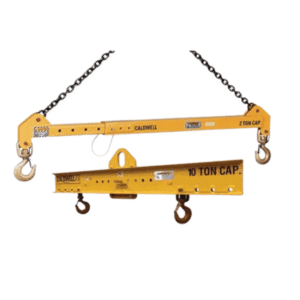
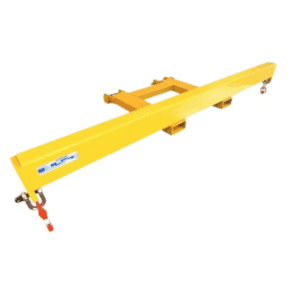
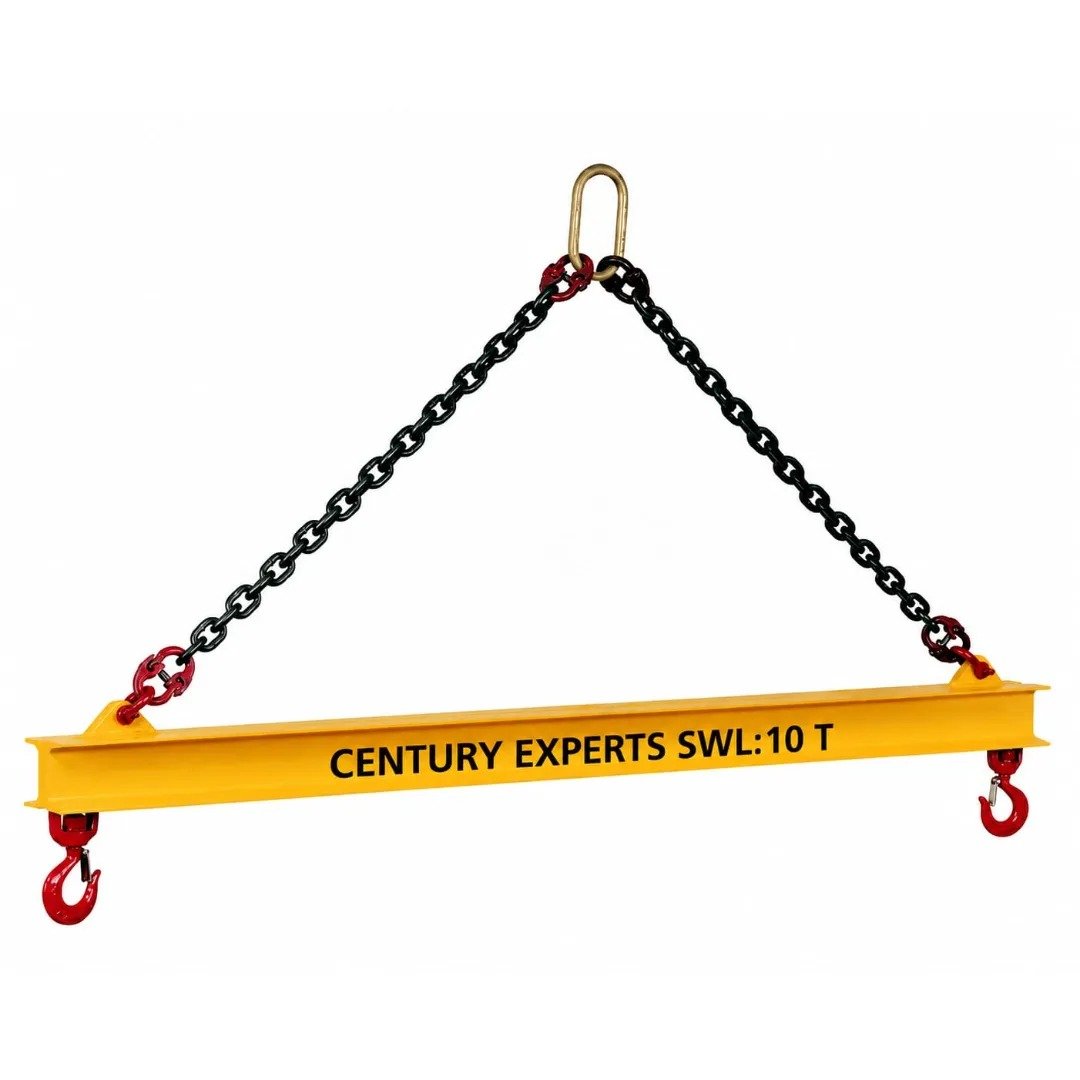
A Spreader Bar is a rigid steel lifting device connected between the crane hook and the load’s slings, engineered to hold the sling attachment points apart at a fixed distance. Instead of slings angling inward toward a single hook and squeezing the load, a spreader bar pushes them outward, keeping wide, long, or fragile loads level and free from compressive side-loading during the lift.
Century Experts fabricates Spreader Bars from certified structural steel, welded by qualified personnel under approved procedures, with the top hook centered over the load and lower attachment points fixed at a set spacing to match the item being lifted. This makes them a simple, reliable choice for loads with a known, unchanging width, without the added complexity of an adjustable or telescopic design.
We supply both standard off-the-shelf Spreader Bars and project-specific custom designs, engineered to the exact length, capacity, and attachment configuration your lift requires. Engineering calculations, weld inspection, proof load testing, and third-party certification are available on request.
Century Experts delivers Spreader Bars to sites and workshops throughout Riyadh, Jeddah, Dammam, Jubail, Al Khobar, Yanbu, Makkah, Madinah, Qassim, Al Kharj, NEOM, and every other region of Saudi Arabia.
Applications
Our Spreader Bars are suitable for:
- Precast Concrete Panel and Slab Lifting
- Glass and Facade Panel Handling
- Solar Panel and Module Lifting
- Structural Steel Section Lifting
- Fragile or Surface-Sensitive Load Handling
- Pipe and Duct Section Lifting
- Container and Crate Lifting
- Marine and Shipyard Fabrication Lifting
- Warehouse and Factory Load Movement
- Power Plant Equipment Handling
- Repetitive Fixed-Dimension Lifting Operations
- General Industrial Two-Point Lifting Requirements
Features
- Heavy-duty structural steel construction
- Fixed-length rigid beam design
- Central top lifting point for crane hook connection
- Outward-set lower attachment points to prevent load compression
- Eliminates sling angle and pinching effect on wide loads
- Smooth weld finish
- Powder-coated or industrial paint finish
- Custom lengths and capacities available
- Identification plate with rated capacity and serial number
- Suitable for indoor and outdoor industrial environments
Why Choose Century Experts
- Custom-designed fabrication solutions
- Experienced engineering and fabrication team
- High-quality workmanship
- Qualified welding procedures
- Engineering calculations available
- Proof load testing available
- Third-party inspection support
- Fast manufacturing and delivery
- Complete documentation package
- Supply across all regions of Saudi Arabia
Standards & Compliance
Our Spreader Bars are designed and manufactured in accordance with applicable project requirements and internationally recognized standards, including:
- ASME B30.20 – Below-the-Hook Lifting Devices
- ASME BTH-1 – Design of Below-the-Hook Lifting Devices
- OSHA 29 CFR 1926.1413 – Wire Rope, Below-the-Hook Devices and Rigging
- Third-party inspection requirements (upon client request)
- Client specifications and project requirements
Compliance is subject to the approved design, client specifications, applicable project requirements, and relevant regulatory standards.
Frequently Asked Questions (FAQ)
1. What is a Spreader Bar?
A Spreader Bar is a rigid steel bar connected between the crane hook and the load’s slings, with a fixed length that holds the sling attachment points apart at a set distance, keeping compressive force off the load and preventing the slings from angling inward.
2. How is a Spreader Bar different from a Lifting Beam?
A Lifting Beam typically suspends the load with slings hanging below it, while a Spreader Bar pushes the sling attachment points outward, holding slings apart rather than bringing them together, which is better suited to wide or fragile loads that shouldn’t be compressed inward.
3. What load capacities are available?
We manufacture Spreader Bars from light-duty capacities for panel and module handling up to heavy-duty capacities for structural steel and precast lifting, with capacity determined by bar length, section size, and attachment point spacing.
4. Will the bar prevent my load from being crushed or bent during lifting?
Yes, that is the primary purpose of a spreader bar. By holding the sling points apart at a fixed distance rather than allowing them to angle inward, it removes the compressive squeeze that direct sling rigging can apply to wide or fragile items such as panels, glass, or solar modules.
5. Can the bar be designed for more than two lifting points?
Yes. While the standard configuration uses two lower attachment points, we can engineer bars with three or four points for loads requiring additional support along their length or width.
6. Does the beam’s own weight need to be considered when planning the lift?
Yes. The spreader bar’s self-weight adds to the total load being handled by the crane, so the crane’s rated capacity should be checked against the combined weight of the bar plus the load, not the load weight alone.
7. What standards does your Spreader Bar comply with?
Our Spreader Bars can be designed and manufactured in accordance with ASME B30.20, ASME BTH-1, OSHA 29 CFR 1926.1413, and project-specific client requirements.
8. Is testing and certification available for the Spreader Bar?
Yes. We provide proof load testing, third-party inspection through approved agencies, and a Certificate of Conformity for every Spreader Bar, along with an identification plate showing rated capacity and serial number.
9. Can the Spreader Bar be customized for our specific load?
Yes. We fabricate Spreader Bars to custom length, capacity, attachment point spacing, and finish, based on the load dimensions and rigging arrangement used at your site.